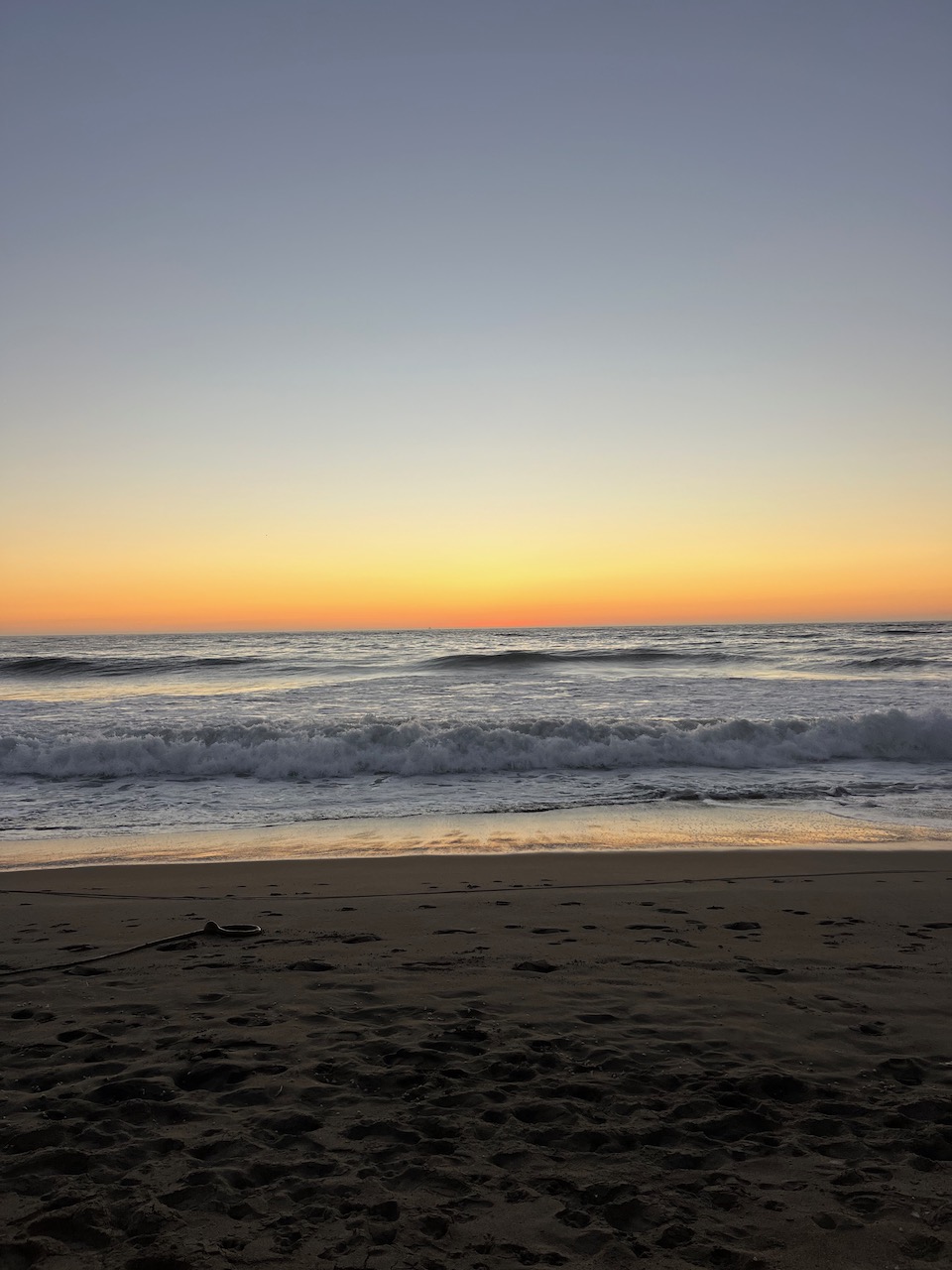
I say I didn’t plan to come back to California, yet in my own words I find contradictions to this claim. That I cannot explain why I chose to leave, that I planned to come back in two years or five years or ten, and that I refuse to give up my driver’s license in the meantime. I find reckless commitment to new places and fantasies in the unknown, they read like enchantment, mostly, for a new stretch of sky, for the light that reflected off the corner of the brick apartment across from mine. Reading them now, I think I must have momentarily forgotten what it feels like to sit at the edge of the Pacific, and to smell an entire landscape in the fog. I let the surf pound into my thighs and the sand cling to the space between my skin and my swimsuit. I taste the salt water, and I could tell you, this is the Pacific. It wouldn’t matter where I had come from, I could tell you, this is home.
—
It’s hard to find answers amongst the contradictions of my own words, so I start looking in the words of others. Didion, I think, might tell me why I find myself back in California, what it means, that I have conceded to the landscapes I have always known. I find an explanation for the Californian obsession with transformative natural experience, that my 6 am climb up Mt. Tam for sunrise has been known, ‘a convenient transformative experience’, for decades. I find the history of Hollister ranch, an exit during our family trips south, between Gilroy and Salinas. What I am surprised to find is my last name, attached to this Californian history. A Lottie Steffens, married into the Hollister family, the Steffens family house in Sacramento, which became the Governor’s Mansion. The quoted biography of Lottie’s brother Lincoln, in which he writes, ‘I never felt the warm, colorful force of the beauty of California, until I had gone away and come back over my father’s route.’
I will explain a caveat, in this new-found connection to my state’s history. My father, Carl Henry Steffens, Jr., was himself born in California, a few blocks off the El Camino on the Peninsula. His mother, the daughter of Mormon settlers in Utah, his father, the son of corn farmers in Iowa. The father of Carl Henry Steffens, Sr., though, left Iowa before Carl was born, his name lost when his mother, Mae, married Charles Steffens. Growing up, we referred to this lost father as the traveling salesman, fascinated at the possible inaccuracy of our family name.
Still, I wonder if California is written in the genes of this name, which may or may not be my own, that I discover in Didion’s pages. Perhaps this is why, in my departure, I chose to drive across the state, West to East. Perhaps this is why, upon my return, I canceled my flight the afternoon of, and instead rented a car so that I could drive the coastal stretch, East to West, from Carpinteria to Gaviota, and then North, where the words of Steinbeck are inscribed on the hills of King City and Salinas, burnt golden in the dry heat of summer.
I try the dense pages of Sapolsky, too, he’s written what feels like an anthology in weight, it’s called Determined, and somewhere in it there is an explanation for why my choices are not a product of free will, but of my biology. It’s hard to find a simple answer in the neuroscience jargon, I try to explain to my mom what I am reading, only to discover she knows the name Sapolsky, from her days as a research assistant in the Stanford primate lab. She recalls her discomfort at having to separate mama squirrel monkeys and their young, and record the behavior that followed. What I can gather in this density is that there are biological mechanisms, deep within my cells, that have made decisions for me before I know they are mine to make.
—
So maybe Sapolsky is right. Maybe I haven’t made these choices at all. I trace the days, I trace the weeks, I trace the years, and when I step back to look at what I have drawn, I see only a single, thickening, contour. Have I found perspective, in this?
In a yellow kitchen in Rockridge, I put my hands over my friend’s belly, I’ve overlooked the series of ultrasound pictures tacked onto the fridge, but when she tells me she’s pregnant I feel the house swelling in anticipation. We drink lemonade on the patio, across from the Temescal farmers’ market, we reminisce on the mornings we spent here three years ago, and four, Santa Rosa plums and sungold tomatoes weighing our bags down on the walk home.
I sat in Precita Park, on one of these Sundays last September, I hiked up the steps over Bernal on the type of clear, warm weekend I did not believe existed in this city. We drank champagne for a reason I can’t recall. I was visiting, and I was about to fall quickly in love with the Southeast fall, but I didn’t know it, yet. Tonight, back in the kitchen in Bernal, we sip kölsch and cook the market’s tomato bounty down in olive oil and wait for the pasta to boil.
I drive home through Twin Peaks and a corner of the Sunset, the fog is dense and dripping, and I see another September Sunday, this one, five years back. My now pregnant friend is living in a one-bedroom in Noe Valley, there’s a deep blue couch and a collection of houseplants to water, and steps on the fire escape where I can imagine drinking my morning coffee. I make a trip from Berkeley to join her for a monthly ocean plunge, she drives us over the hill and down to the Great Highway. We plunge, we pull on our sweats and puffys, we stop for scones at Devil’s Teeth and on the drive back over the hill, we talk about her new nephew. Her own desire to become a mom is distant, not yet tangible.
There are four more Septembers. I spend the morning trying to catch longboard waves at Ocean Beach, I still feel the swell of her belly, I will wake up to the softness of a clear San Francisco morning, in the space the fog has left.
 Sophia Steffens